Butchered Cows Hanging Weight to Finished Weight Beef
The Seven Rules for Producing Corking Beef: 1 2 3 4 5 6 vii
Feeding cattle:
gauging the correct finishing weights on pasture
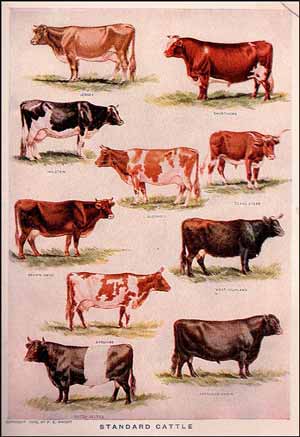
Image Credit: Sue Clark, Flickr, CC BY two.0
In the previous article of this series (Dominion # i) nigh theSeven Unbreakable Rules for Producing Great Beefiness, I explained how, when feeding cattle for slaughter, beefiness tenderness and season depends on microscopic intramuscular fat deep within the muscle fibers of the beef animal.
I also explained that this vital microscopic intramuscular fat is only deposited in one case cattle reach maturity - information technology does not develop in younger cattle no thing how obese they get.
But beef cattle come in many different sizes, which means that the time it takes to fatten cattle for slaughter will vary dramatically depending on their size. This has some serious implications for how yous structure your cattle finishing strategy.
This article I will explore how the breed and size of individual cattle affects their target "finished weight" when they are fat enough to go to slaughter.

(Rule # ii)
The 'finished weight' when an animate being is fat enough for slaughter will vary from brood to breed and depends on the frame size of the individual animal.
Frame Size vs Finishing Weight
A smaller-boned fauna stops growing before than a larger-boned beast. It will therefore exist finished sooner, just at a lighter weight than a taller larger-framed creature. While this seems rather obvious, it is a key reason why many novice grass-fed producers feeding cattle for slaughter fail to produce consistently tender, flavorful beefiness.
A common mistake among many pasture-finishing programs is that they fail to business relationship for size differences in their cattle finishing programs. They often desire to slaughter all their calves by the end of the second growing season to avoid another winter of high feed costs. But larger-sized calves within the group will still be underfinished - they need more fourth dimension. If they are slaughtered at the aforementioned time as the smaller-framed calves, their beefiness volition be tough.
The expectations of a cattle finishing program must exist suited to the size of the cattle being finished. A grass-fed producer simply cannot await to slaughter a Simmental steer at 18 months of historic period and at 1060 lbs when the bulk of his Angus steers will exist set up. He will need to concord his Simmental calves over some other wintertime, slaughtering them when they reaches virtually 1400 lbs at effectually 24-26 months of age. About tropical cattle breeds get fifty-fifty larger (1700 lbs or more), and take even longer (thirty+ months)!
Target finishing weight is individual. It is non the same for all cattle even from the aforementioned brood.
Either choice cattle genetics to match the expectations y'all have for your grass-finishing program or blueprint your grass-finishing program to suit the cattle genetics that you already own.
Nor is it true that all cattle from a unmarried brood will take the same target finishing weight.
Target finishing weight actually depends on the size (bone structure) of every single private animal. And although cattle from inside the same breed are sized relatively similarly, in that location are nonetheless sufficient size differences within any breed that you actually accept to accommodate the target finishing weight for every individual beast to account for individual size differences.
The article about hip tiptop vs target slaughter weight provides the look-up tables for steers, heifers, mature cows and mature bulls and then you lot can calculate the exact target slaughter weight of every single animal on your farm, but by measuring their hip heights.
You can learn more about how to select the ideal breed to adjust your climate, environmental conditions and marketing strategy in the "Genetics and Convenance" chapter of Grass-fed Cattle: How to Produce and Market Natural Beef.
Tips for Evaluating Cattle Slaughter-Readiness on Pasture
When feeding cattle in a feedlot, cattle are more often than not organized past age and weight. If at that place are plenty animals they are likewise divided by size (i.e. all medium-framed animals grouped together).
Gauging slaughter-readiness then becomes a unproblematic matter of periodically weighing the cattle to assess if the majority of the group has reached their platonic target weight based on the hip tiptop vs slaughter weight lookup tables I discussed in a higher place
While this strategy works well in a feedlot setting, when feeding cattle for slaughter on pasture you lot exercise non need to sort them into size-groups or constantly weigh them. With experience, grass-fed cattle producers tin can become very expert at judging whether their cattle are fat enough for slaughter. It is a combination of knowing your breed's characteristics (i.e. what does a typical finished Angus or Simmental look like), approximating their weight, and judging how fatty they expect.
The first few times you evaluate cattle past middle this may seem rather daunting, but you can train your eye with experience. Whenever you have the cattle in the corral, take the fourth dimension to measure out their hip heights and weight them, and so use the look-upwards tables to run into how close they are to being finished. You will soon get quite adept at eyeballing when it'southward time for the beeves to get to slaughter. Experienced cattlemen ofttimes acquire to approximate their cattle's weights to within 25 to 40 pounds.
Owning a skilful weigh calibration is vital if you lot are finishing cattle for slaughter. It is a good tool to assist you calibrate your eye, only most important of all, information technology is essential to provide the final confirmation that your cattle have indeed reached their target weight prior to loading them onto the truck destined for market.
(Disclosure: I become commissions for purchases made using Amazon links in my post.)
You practise not need to spend thousands of dollars to get a stand-alone cattle weigh calibration. The cheapest solution is to simply mount a prepare of weigh confined #CommissionsEarned underneath your cattle clasp.
Moving On...
This correlation between hip meridian and target slaughter weight is the most of import footstep in producing consistently tender flavorful beef. Only there are lots of little obstacles that can still undermine tenderness and flavour by temporarily draining the vital fatty from the microscopic intramuscular fatty cells discussed in Rule #1, fifty-fifty if the cattle have reached their target slaughter weight!
These obstacles are the subject of the remaining manufactures in this series about the Seven Rules of Producing Great Beefiness.
The adjacent article in the series will explain why reaching the target weight is non enough. Cattle must likewise still be gaining weight at the fourth dimension they are slaughtered if you lot want the beef to retain all its tenderness and flavor.
- Cattle Farming ›
- Beef Producer's Guide ›
- Finishing by Frame Size & Brood

Affiliate products.
In my manufactures I recommend some of my favorite cattle farming books and products. If you lot buy something through i of those links, I receive a small commission. There is no additional toll to you. To acquire more, please see my affiliate disclosure document.
Source: https://www.grass-fed-solutions.com/feeding-cattle.html
0 Response to "Butchered Cows Hanging Weight to Finished Weight Beef"
Postar um comentário