Whom Does Antigone Blame for the Tragic History of Her Family?
| Antigone | |
|---|---|
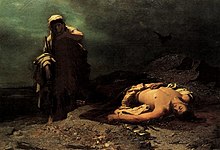 Antigone in forepart of the dead Polynices past Nikiforos Lytras 1865 | |
| Written past | Sophocles |
| Chorus | Theban Elders |
| Characters | Antigone Ismene Creon Eurydice Haemon Tiresias Sentry Leader of the Chorus First Messenger Second Messenger |
| Mute | Two guards A boy |
| Engagement premiered | c. 441 BCE |
| Place premiered | Athens |
| Original linguistic communication | Ancient Greek |
| Genre | Tragedy |
Antigone ( ann-TIG-ə-nee; Ancient Greek: Ἀντιγόνη) is a tragedy by Sophocles written in or before 441 BC.
Of the 3 Theban plays Antigone is the 3rd in order of the events depicted in the plays, only it is the get-go that was written.[1] The play expands on the Theban legend that predates it, and information technology picks upward where Aeschylus' Seven Against Thebes ends.
Synopsis [edit]
Prior to the beginning of the play, the brothers Eteocles and Polynices, leading reverse sides in Thebes' civil war, died fighting each other for the throne. Creon, the new ruler of Thebes and brother of the quondam Queen Jocasta, has decided that Eteocles will be honored and Polynices will be in public shame. The rebel brother's body will not be sanctified past holy rites and will prevarication unburied on the battlefield, prey for carrion animals like vultures and jackals[ co-ordinate to whom? ], the harshest penalty at the fourth dimension. Antigone and Ismene are the sisters of the dead Polynices and Eteocles.
| Laius | Jocasta | Creon | |||||||||||||||||||||||||||||||||||||
| Oedipus | |||||||||||||||||||||||||||||||||||||||
| Eteocles | Polynices | Ismene | Antigone | Haemon | |||||||||||||||||||||||||||||||||||
In the opening of the play, Antigone brings Ismene outside the palace gates belatedly at night for a hush-hush meeting: Antigone wants to coffin Polynices' trunk, in defiance of Creon's edict. Ismene refuses to help her, non believing that it will actually be possible to bury their brother, who is under baby-sit, but she is unable to cease Antigone from going to bury her brother herself.
The chorus enter and bandage the background story of the Seven confronting Thebes into a mythic and heroic context.
Creon enters, and seeks the support of the chorus of Theban elders in the days to come and in detail, wants them to dorsum his edict regarding the disposal of Polynices' body. The leader of the chorus pledges his support out of deference to Creon. A sentry enters, fearfully reporting that the body has been given funeral rites and a symbolic burying with a thin covering of world, though no i sees who actually committed the crime. Creon, furious, orders the picket to find the culprit or face death himself. The sentry leaves.
The sentinel returns, bringing Antigone with him. The picket explains that the watchmen uncovered Polynices' body so defenseless Antigone every bit she did the funeral rituals. Creon questions her later sending the sentry away, and she does not deny what she has done. She argues unflinchingly with Creon well-nigh the immorality of the edict and the morality of her actions. Creon becomes furious, and seeing Ismene upset, thinks she must have known of Antigone's plan. He summons her. Ismene tries to confess falsely to the law-breaking, wishing to die aslope her sister, but Antigone will not have information technology. Creon orders that the two women be imprisoned. The chorus sing of the troubles of the house of Oedipus. Haemon, Creon'due south son, enters to pledge allegiance to his male parent, even though he is engaged to Antigone. He initially seems willing to forsake Antigone, simply when Haemon gently tries to persuade his father to spare Antigone, claiming that "nether comprehend of darkness the city mourns for the girl", the word deteriorates, and the two men are soon bitterly insulting each other. When Creon threatens to execute Antigone in front of his son, Haemon leaves, vowing never to run across Creon again.
The chorus sing of the power of love. Antigone is brought in nether baby-sit on her mode to execution. She sings a lament. The chorus compares her to the goddess Niobe, who was turned into a rock, and say it is a wonderful thing to be compared to a goddess. Antigone accuses them of mocking her.
Creon decides to spare Ismene and to bury Antigone alive in a cave. By not killing her directly, he hopes to pay minimal respects to the gods. She is brought out of the house, and this fourth dimension, she is sorrowful instead of defiant. She expresses her regrets at not having married and dying for post-obit the laws of the gods. She is taken abroad to her living tomb.
The Chorus encourages Antigone by singing of the nifty women of myth who suffered.
Tiresias, the bullheaded prophet, enters. Tiresias warns Creon that Polynices should now exist urgently buried because the gods are displeased, refusing to have any sacrifices or prayers from Thebes. Withal, Creon accuses Tiresias of being decadent. Tiresias responds that Creon will lose "a son of [his] own loins"[2] for the crimes of leaving Polynices unburied and putting Antigone into the earth (he does not say that Antigone should non be condemned to death, only that it is improper to keep a living body underneath the earth). Tiresias also prophesies that all of Hellenic republic volition despise Creon and that the sacrificial offerings of Thebes will non be accepted past the gods. The leader of the chorus, terrified, asks Creon to take Tiresias' advice to free Antigone and coffin Polynices. Creon assents, leaving with a retinue of men. The chorus delivers an oral ode to the god Dionysus.
A messenger enters to tell the leader of the chorus that Haemon has killed himself. Eurydice, Creon's wife and Haemon's mother, enters and asks the messenger to tell her everything. The messenger reports that Creon saw to the burial of Polynices. When Creon arrived at Antigone'southward cave, he plant Haemon lamenting over Antigone, who had hanged herself. Haemon unsuccessfully attempted to stab Creon, then stabbed himself. Having listened to the messenger'due south account, Eurydice silently disappears into the palace.
Creon enters, conveying Haemon'southward body. He understands that his own actions have caused these events and blames himself. A second messenger arrives to tell Creon and the chorus that Eurydice has killed herself. With her last jiff, she cursed her husband for the deaths of her sons, Haemon and Megareus. Creon blames himself for everything that has happened, and, a broken man, he asks his servants to assist him inside. The order he valued and then much has been protected, and he is nonetheless the king, but he has acted against the gods and lost his children and his wife as a upshot. After Creon condemns himself, the leader of the chorus closes past saying that although the gods punish the proud, punishment brings wisdom.
Characters [edit]
- Antigone, compared to her beautiful and docile sister, is portrayed as a heroine who recognizes her familial duty. Her dialogues with Ismene reveal her to exist as stubborn every bit her uncle.[iii] In her, the ideal of the female character is boldly outlined.[4] She defies Creon'south decree despite the consequences she may face, in order to award her deceased blood brother.
- Ismene serves every bit a foil for Antigone, presenting the contrast in their respective responses to the royal decree.[3] Considered the beautiful one, she is more lawful and obedient to authority. She hesitates to bury Polynices considering she fears Creon.
- Creon is the electric current Rex of Thebes, who views law equally the guarantor of personal happiness. He can also be seen as a tragic hero, losing everything for upholding what he believed was correct. Fifty-fifty when he is forced to meliorate his prescript to delight the gods, he showtime tends to the dead Polynices before releasing Antigone.[3]
- Eurydice of Thebes is the Queen of Thebes and Creon's married woman. She appears towards the finish and but to hear confirmation of her son Haemon's death. In her grief, she commits suicide, blasphemous Creon whom she blames for her son's death.
- Haemon is the son of Creon and Eurydice, betrothed to Antigone. Proved to be more reasonable than Creon, he attempts to reason with his father for the sake of Antigone. Yet, when Creon refuses to listen to him, Haemon leaves angrily and shouts he volition never see him again. He commits suicide afterward finding Antigone dead.
- Koryphaios is the assistant to the Male monarch (Creon) and the leader of the Chorus. He is oft interpreted as a close advisor to the King, and therefore a close family friend. This role is highlighted in the end when Creon chooses to listen to Koryphaios' advice.
- Tiresias is the bullheaded prophet whose prediction brings nigh the eventual proper burying of Polynices. Portrayed as wise and full of reason, Tiresias attempts to warn Creon of his foolishness and tells him the gods are aroused. He manages to convince Creon, merely is too tardily to salvage the impetuous Antigone.
- The Chorus, a group of elderly Theban men, is at first deferential to the king.[4] Their purpose is to comment on the activity in the play and add together to the suspense and emotions, as well as connecting the story to myths. As the play progresses they counsel Creon to exist more moderate. Their pleading persuades Creon to spare Ismene. They besides advise Creon to take Tiresias's advice.
Historical context [edit]
Antigone was written at a time of national fervor. In 441 BCE, shortly after the play was performed, Sophocles was appointed as one of the ten generals to lead a military machine expedition against Samos. It is striking that a prominent play in a time of such imperialism contains little political propaganda, no impassioned apostrophe, and, with the exception of the epiklerate (the right of the daughter to continue her expressionless father's lineage),[5] and arguments against anarchy, makes no contemporary innuendo or passing reference to Athens.[half-dozen] Rather than become sidetracked with the issues of the fourth dimension, Antigone remains focused on the characters and themes within the play. It does, yet, expose the dangers of the absolute ruler, or tyrant, in the person of Creon, a king to whom few volition speak freely and openly their true opinions, and who therefore makes the grievous error of condemning Antigone, an act which he pitifully regrets in the play's final lines. Athenians, proud of their autonomous tradition, would have identified his error in the many lines of dialogue which emphasize that the people of Thebes believe he is wrong, but take no vocalization to tell him then. Athenians would identify the folly of tyranny.
Notable features [edit]
The Chorus in Antigone departs significantly from the chorus in Aeschylus' Seven Against Thebes, the play of which Antigone is a continuation. The chorus in Seven Against Thebes is largely supportive of Antigone's decision to coffin her blood brother. Hither, the chorus is composed of former men who are largely unwilling to encounter civil disobedience in a positive light. The chorus likewise represents a typical deviation in Sophocles' plays from those of both Aeschylus and Euripides. A chorus of Aeschylus' virtually always continues or intensifies the moral nature of the play, while one of Euripides' ofttimes strays far from the master moral theme. The chorus in Antigone lies somewhere in betwixt; information technology remains within the full general moral in the immediate scene, but allows itself to be carried abroad from the occasion or the initial reason for speaking.[7]
Significance and interpretation [edit]
In one case Creon has discovered that Antigone buried her brother against his orders, the ensuing discussion of her fate is devoid of arguments for mercy considering of youth or sisterly honey from the Chorus, Haemon or Antigone herself. Almost of the arguments to salvage her center on a debate over which grade adheres all-time to strict justice.[eight] [ix]
Both Antigone and Creon claim divine sanction for their actions; just Tiresias the prophet supports Antigone'southward claim that the gods demand Polynices' burying. It is non until the interview with Tiresias that Creon transgresses and is guilty of sin. He had no divine intimation that his edict would exist displeasing to the Gods and against their will. He is here warned that it is, but he defends it and insults the prophet of the Gods. This is his sin, and it is this which leads to his punishment. The terrible calamities that overtake Creon are not the event of his exalting the law of the state over the unwritten and divine law which Antigone vindicates, but are his intemperance which led him to disregard the warnings of Tiresias until it was too late. This is emphasized by the Chorus in the lines that conclude the play.[10]
The High german poet Friedrich Hölderlin, whose translation had a stiff affect on the philosopher Martin Heidegger, brings out a more than subtle reading of the play: he focuses on Antigone's legal and political status inside the palace, her privilege to be the hearth (according to the legal musical instrument of the epiklerate) and thus protected by Zeus. According to the legal do of classical Athens, Creon is obliged to marry his closest relative (Haemon) to the belatedly king's girl in an inverted wedlock rite, which would oblige Haemon to produce a son and heir for his dead father in law. Creon would be deprived of grandchildren and heirs to his lineage – a fact which provides a strong realistic motive for his hatred confronting Antigone. This modern perspective has remained submerged for a long time.[11]
Heidegger, in his essay, The Ode on Man in Sophocles' Antigone, focuses on the chorus' sequence of stophe and antistrophe that begins on line 278. His interpretation is in iii phases: get-go to consider the essential meaning of the poetry, and and then to motion through the sequence with that understanding, and finally to discern what was nature of humankind that Sophocles was expressing in this poem. In the commencement two lines of the first strophe, in the translation Heidegger used, the chorus says that there are many strange things on earth, only there is cypher stranger than human being. Ancestry are important to Heidegger, and he considered those 2 lines to describe the chief trait of the essence of humanity within which all other aspects must find their essence. Those 2 lines are so primal that the residual of the poesy is spent catching up with them. The authentic Greek definition of humankind is the one who is strangest of all. Heidegger's interpretation of the text describes humankind in i word that captures the extremes — deinotaton. Man is deinon in the sense that he is the terrible, tearing ane, and also in the sense that he uses violence against the overpowering. Human is twice deinon. In a series of lectures in 1942, Hölderlin'due south Hymn, The Ister, Heidegger goes further in interpreting this play, and considers that Antigone takes on the destiny she has been given, but does not follow a path that is opposed to that of the humankind described in the choral ode. When Antigone opposes Creon, her suffering the uncanny, is her supreme action.[12] [13]
The trouble of the 2d burying [edit]
An important issue still debated regarding Sophocles' Antigone is the problem of the second burying. When she poured grit over her brother's torso, Antigone completed the burying rituals and thus fulfilled her duty to him. Having been properly buried, Polynices' soul could proceed to the underworld whether or non the dust was removed from his body. However, Antigone went back after his body was uncovered and performed the ritual once more, an act that seems to be completely unmotivated by anything other than a plot necessity and so that she could be caught in the act of defiance, leaving no doubt of her guilt. More one commentator has suggested that it was the gods, not Antigone, who performed the first burying, citing both the guard'due south description of the scene and the chorus's observation.[14]
Richard C. Jebb suggests that the only reason for Antigone's return to the burial site is that the kickoff time she forgot the Choaí (libations), and "mayhap the rite was considered completed but if the Choaí were poured while the grit still covered the corpse."[15]
Gilbert Norwood explains Antigone's performance of the second burial in terms of her stubbornness. His argument says that had Antigone not been then obsessed with the thought of keeping her brother covered, none of the deaths of the play would have happened. This statement states that if goose egg had happened, cypher would accept happened, and doesn't take much of a stand in explaining why Antigone returned for the 2nd burial when the first would have fulfilled her religious obligation, regardless of how stubborn she was. This leaves that she acted only in passionate defiance of Creon and respect to her brother'due south earthly vessel.[sixteen]
Tycho von Wilamowitz-Moellendorff justifies the need for the 2d burial past comparing Sophocles' Antigone to a theoretical version where Antigone is apprehended during the first burial. In this state of affairs, news of the illegal burial and Antigone'south abort would arrive at the same time and in that location would be no period of fourth dimension in which Antigone's defiance and victory could be appreciated.
J. L. Rose maintains that the solution to the trouble of the second burial is solved past close exam of Antigone as a tragic graphic symbol. Existence a tragic character, she is completely obsessed by 1 thought, and for her this is giving her brother his due respect in death and demonstrating her dear for him and for what is correct. When she sees her brother'due south trunk uncovered, therefore, she is overcome past emotion and acts impulsively to cover him over again, with no regards to the necessity of the activeness or its consequences for her safety.[16]
Bonnie Honig uses the problem of the 2nd burial as the basis for her claim that Ismene performs the get-go burial, and that her pseudo-confession before Creon is actually an honest admission of guilt.[17]
Themes [edit]
Civil defiance [edit]
A well established theme in Antigone is the right of the individual to reject order's infringement on her freedom to perform a personal obligation.[18] Antigone comments to Ismene, regarding Creon's edict, that "He has no right to keep me from my own."[nineteen] Related to this theme is the question of whether Antigone's will to bury her brother is based on rational thought or instinct, a debate whose contributors include Goethe.[xviii]
The contrasting views of Creon and Antigone with regard to laws higher than those of state inform their different conclusions nearly civil disobedience. Creon demands obedience to the law above all else, right or wrong. He says that "there is nothing worse than disobedience to authority" (An. 671). Antigone responds with the idea that land police is non absolute, and that it can be cleaved in civil disobedience in extreme cases, such as honoring the gods, whose rule and potency outweigh Creon's.
Natural law and contemporary legal institutions [edit]
Creon's decree to leave Polynices unburied in itself makes a assuming statement near what it means to exist a denizen, and what constitutes abdication of citizenship. It was the firmly kept custom of the Greeks that each metropolis was responsible for the burial of its citizens. Herodotus discussed how members of each city would collect their ain dead later a large battle to bury them.[20] In Antigone, information technology is therefore natural that the people of Thebes did not coffin the Argives, but very hit that Creon prohibited the burying of Polynices. Since he is a citizen of Thebes, information technology would have been natural for the Thebans to bury him. Creon is telling his people that Polynices has distanced himself from them, and that they are prohibited from treating him as a beau-citizen and burying him every bit is the custom for citizens.
In prohibiting the people of Thebes from burying Polynices, Creon is essentially placing him on the level of the other attackers—the foreign Argives. For Creon, the fact that Polynices has attacked the city finer revokes his citizenship and makes him a greenhorn. As defined by this prescript, citizenship is based on loyalty. It is revoked when Polynices commits what in Creon's eyes amounts to treason. When pitted confronting Antigone's view, this understanding of citizenship creates a new centrality of disharmonize. Antigone does not deny that Polynices has betrayed the state, she just acts every bit if this betrayal does non rob him of the connection that he would have otherwise had with the city. Creon, on the other hand, believes that citizenship is a contract; it is not accented or inalienable, and can be lost in certain circumstances. These 2 opposing views – that citizenship is absolute and undeniable and alternatively that citizenship is based on certain behavior – are known respectively as citizenship 'past nature' and citizenship 'by police.'[twenty]
Fidelity [edit]
Antigone's determination to bury Polynices arises from a want to bring honor to her family, and to accolade the higher law of the gods. She repeatedly declares that she must act to please "those that are dead" (An. 77), because they hold more weight than any ruler, that is the weight of divine constabulary. In the opening scene, she makes an emotional appeal to her sis Ismene proverb that they must protect their brother out of sisterly honey, fifty-fifty if he did betray their land. Antigone believes that in that location are rights that are inalienable considering they come from the highest authority, or say-so itself, that is the divine law.
While he rejects Antigone'southward deportment based on family honor, Creon appears to value family himself. When talking to Haemon, Creon demands of him non only obedience equally a citizen, but besides every bit a son. Creon says "everything else shall be second to your male parent's determination" ("An." 640–641). His emphasis on being Haemon's father rather than his male monarch may seem odd, especially in light of the fact that Creon elsewhere advocates obedience to the state above all else. It is non clear how he would personally handle these two values in conflict, merely it is a moot point in the play, for, as absolute ruler of Thebes, Creon is the state, and the state is Creon. It is clear how he feels about these ii values in conflict when encountered in another person, Antigone: loyalty to the state comes before family fealty, and he sentences her to expiry.
Portrayal of the gods [edit]
In Antigone besides as the other Theban Plays, at that place are very few references to the gods. Hades is the god who is nearly usually referred to, but he is referred to more as a personification of Decease. Zeus is referenced a total of 13 times past name in the entire play, and Apollo is referenced only equally a personification of prophecy. This lack of mention portrays the tragic events that occur every bit the event of human error, and not divine intervention. The gods are portrayed equally chthonic, as nearly the commencement there is a reference to "Justice who dwells with the gods beneath the earth." Sophocles references Olympus twice in Antigone. This contrasts with the other Athenian tragedians, who reference Olympus often.
Honey for family [edit]
Antigone'southward love for family is shown when she buries her brother, Polynices. Haemon was deeply in dear with his cousin and fiancée Antigone, and he killed himself in grief when he found out that his dearest Antigone had hanged herself.
Modern adaptations [edit]
Drama [edit]
- Felix Mendelssohn composed a suite of incidental music for Ludwig Tieck'southward staging of the play in 1841. Information technology includes an overture and seven choruses.
- Walter Hasenclever wrote an accommodation in 1917, inspired by the events of World War I.
- Jean Cocteau created an adaptation of Sophocles' Antigone at Théâtre de l'Atelier in Paris on Dec 22nd, 1922.
- French playwright Jean Anouilh'southward tragedy Antigone was inspired by both Sophocles' play and the myth itself. Anouilh's play premièred in Paris at the Théâtre de fifty'Atelier in February 1944, during the Nazi occupation of France.
- Right afterwards Globe War 2, Bertolt Brecht composed an adaptation, Antigone, which was based on a translation by Friedrich Hölderlin and was published under the title Antigonemodell 1948.
- The Haitian writer and playwright Félix Morisseau-Leroy translated and adjusted Antigone into Haitian Creole under the title, Antigòn (1953). Antigòn is noteworthy in its attempts to insert the lived religious feel of many Haitians into the content of the play through the introduction of several Loa from the pantheon of Haitian Vodou as voiced entities throughout the performance.
- Antigone inspired the 1967 Castilian-linguistic communication novel La tumba de Antígona (English language title: Antigone'due south Tomb) by María Zambrano.
- Puerto Rican playwright Luis Rafael Sánchez'southward 1968 play La Pasión según Antígona Pérez sets Sophocles' play in a contemporary world where Creon is the dictator of a fictional Latin American nation, and Antígona and her 'brothers' are dissident freedom fighters.
- The Island, a 1973 apartheid-era play by the S African playwrights Athol Fugard, John Kani, and Winston Nthsona, features ii cellmates who rehearse and ultimately perform Antigone for the other prisoners, drawing parallels between Antigone herself and black political prisoners held in Robben Island prison house.
- In 1977, Antigone was translated into Papiamento for an Aruban product past managing director Burny Every together with Pedro Velásquez and Ramon Todd Dandaré. This translation retains the original iambic poesy past Sophocles.
- In 2004, theatre companies Crossing Jamaica Avenue and The Women'due south Project in New York Metropolis co-produced the Antigone Project written past Tanya Barfield, Karen Hartman, Chiori Miyagawa, Pulitzer Prize winner Lynn Nottage and Caridad Svich, a five-part response to Sophocles' text and to the US Patriot Act. The text was published by NoPassport Printing as a single edition in 2009 with introductions by classics scholar Marianne McDonald and playwright Lisa Schlesinger.
- Bangladeshi director Tanvir Mokammel in his 2008 motion-picture show Rabeya (The Sis) also draws inspiration from Antigone to parallel the story to the martyrs of the 1971 Bangladeshi Liberation War who were denied a proper burial.[21]
- In 2000, Peruvian theatre group Yuyachkani and poet José Watanabe adapted the play into a one-player piece which remains as part of the group's repertoire.[22]
- An Iranian absurdist accommodation of Antigone was written and directed past Homayoun Ghanizadeh and staged at the Urban center Theatre in Tehran in 2011.[23]
- In 2012, the Regal National Theatre adapted Antigone to modern times. Directed by Polly Findlay,[24] the product transformed the dead Polynices into a terrorist threat and Antigone into a "unsafe subversive."[25]
- Roy Williams'due south 2014 adaptation of Antigone for the Airplane pilot Theatre relocates the setting to contemporary street culture.[26]
- Syrian playwright Mohammad Al-Attar adjusted Antigone for a 2014 production at Beirut, performed past Syrian refugee women.[27]
- "Antigone in Ferguson" is an adaptation conceived in the wake of Michael Brown's death in 2014, through a collaboration betwixt Theater of State of war Productions and community members from Ferguson, Missouri. Translated and directed by Theater of War Productions Artistic Managing director Bryan Doerries and composed by Phil Woodmore.[28]
Opera [edit]
- Antigone, opera by Arthur Honegger, premiered on December 28, 1927 at Théâtre de la Monnaie in Bruxelles.
- Antigonae, opera past Carl Orff, a Literaturoper which uses Friedrich Hölderlin'due south translation of Sophokles' drama (1805), premiered on August eight, 1949 at the Felsenreitschule in the context of Salzburg Festival.
- Antigone (1977) by Dinos Constantinides, on an English libretto by Fitts and Fitzgerald
- Antigone (1986) by Marjorie S. Merryman
- Antigone oder die Stadt (1988) by Georg Katzer with a libretto by Gerhard Müller, premiered at the Komische Oper Berlin in 1991, staged by Harry Kupfer and conducted by Jörg-Peter Weigle
- The Burial at Thebes (2007–2008) by Dominique Le Gendre and libretto by Seamus Heaney, based on his translation for spoken theatre. The production features conductor William Lumpkin, stage managing director Jim Petosa, and six singers and ten instrumentalists.[29]
Literature [edit]
In 2017 Kamila Shamsie published Habitation Fire, which transposes some of the moral and political questions in Antigone into the context of Islam, ISIS and modern-twenty-four hour period Great britain.
Movie house [edit]
Yorgos Tzavellas adapted the play into a 1961 moving picture which he also directed. It featured Irene Papas equally Antigone.
Liliana Cavani'due south 1970 I Cannibali is a contemporary political fantasy based upon the Sophocles play, with Britt Ekland equally Antigone and Pierre Clémenti as Tiresias.
The 1978 jitney moving-picture show Germany in Autumn features a segment by Heinrich Böll entitled "The Deferred Antigone"[30] where a fictional product of Antigone is presented to television executives who reject it as "too topical".[31]
A 2019 Canadian film adaption transposed the story into ane of a modern day immigrant family in Montreal. It was adjusted and directed by Sophie Deraspe, with boosted inspiration from the Death of Fredy Villanueva. Antigone was played by Nahéma Ricci.
Tv [edit]
Information technology was filmed for Australian TV in 1966.
In 1986, Juliet Stevenson starred as Antigone, with John Shrapnel as Creon and John Gielgud as Tiresias in the BBC's The Theban Plays.
Antigone at the Barbican was a 2015 filmed-for-Television receiver version of a production at the Barbican directed by Ivo van Hove; the translation was past Anne Carson and the motion-picture show starred Juliette Binoche as Antigone and Patrick O'Kane equally Kreon.
Other Goggle box adaptations of Antigone accept starred Irene Worth (1949) and Dorothy Tutin (1959), both circulate by the BBC.
Translations and adaptations [edit]
- 1550 – Georgio Rotallero: text in Latin
- 1729 – George Adams, prose: full text
- 1782 – Vittorio Alfieri, in hendecasyllables: text in Italian
- 1839 – Johann Jakob Christian Donner, German poesy
- 1865 – Edward H. Plumptre, poesy (Harvard Classics Vol. VIII, Part 6. New York: P.F. Collier & Son, 1909–xiv); full text
- 1888 – Sir George Young, poesy (Dover, 2006; ISBN 978-0-486-45049-0)
- 1899 – M. H. Palmer, poetry (Boston: Houghton and Mifflin, 1899)
- 1904 – Richard C. Jebb, prose: total text
- 1911 – Joseph Edward Harry, verse (Cincinnati: Robert Clarke, 1911)
- 1912 – F. Storr, poetry: full text
- 1926 – Ettore Romagnoli, in hendecasyllables, text in Italian
- 1931 – Shaemas O'Sheel, prose
- 1938 – Dudley Fitts and Robert Fitzgerald, verse: total text
- 1946 – Jean Anouilh, (modern French translation)
- 1947 – E. F. Watling, poesy (Penguin classics)
- 1949 – Robert Whitelaw, poetry (Rinehart Editions)
- 1950 – Theodore Howard Banks, poesy
- 1950 – Due west. J. Gruffydd (translation into Welsh)
- 1953 – Félix Morisseau-Leroy (translated and adapted into Haitian Creole)
- 1954 – Elizabeth Wyckoff, verse
- 1954 – F. L. Lucas, verse translation
- 1956 – Shahrokh Meskoob (into Western farsi)
- 1958 – Paul Roche, poesy
- 1962 – H. D. F. Kitto, poetry
- 1962 – Michael Townsend, (Longman, 1997; ISBN 978-0-8102-0214-six)
- 1973 – Richard Emil Braun, poesy
- 1982 – Robert Fagles, poetry with introduction and notes by Bernard Knox
- 1986 – Don Taylor, prose (The Theban Plays, Methuen Drama; ISBN 978-0-413-42460-0)
- 1991 – David Grene, poetry
- 1994 – Hugh Lloyd-Jones, verse (Sophocles, Volume Two: Antigone, The Women of Trachis, Philoctetes, Oedipus at Colonus, Loeb Classical Library No. 21, 1994; ISBN 978-0-674-99558-1)
- 1997 – George Judy, adaptation for children (Pioneer Drama, 1997)
- 1998 – Cerise Blondell, prose with introduction and interpretive essay (Focus Classical Library, Focus Publishing/R Pullins Company; ISBN 0-941051-25-0)
- 1999 – Declan Donnellan, with introduction by Nicholas Dromgoole (Oberon Books, 1999; ISBN 978-ane-840-02136-3)
- 2000 – Marianne MacDonald, (Nick Hern Books, 2000; ISBN 978-i-85459-200-2)
- 2001 – Paul Woodruff, verse (Hackett, 2001; ISBN 978-0-87220-571-0)
- 2003 – Reginald Gibbons and Charles Segal, verse (Oxford Upwards, 2007; ISBN 978-0-19-514310-2)
- 2004 – Seamus Heaney, The Burying at Thebes – verse accommodation (Farrar, Straus and Giroux, 2005; ISBN 978-0-374-53007-five), also adapted every bit an opera in 2008
- 2005 – Ian C. Johnston, verse (modern English): full text
- 2006 – George Theodoridis, prose: total text
- 2006 – A. F. Th. van der Heijden, 'Drijfzand koloniseren' ("Colonizing quicksand"), prose, adapting Antigone's story using characters from the author's 'Human Duplex' saga.
- 2009 – Tanya Barfield, Karen Hartman, Lynn Nottage, Chiori Miyagawa, Caridad Svich, play accommodation (NoPassport Press, 2009; ISBN 978-0-578-03150-seven)
- 2011 - Diane Rayor, Sophocles' Antigone: A New Translation. Cambridge University Press.
- 2012 – Anne Carson, play adaptation (Antigonick, New Directions Press; ISBN 978-0-811-21957-0)
- 2013 – George Porter, verse ("Black Antigone: Sophocles' tragedy meets the heartbeat of Africa", ISBN 978-ane-909-18323-0)
- 2014 – Marie Slaight and Terrence Tasker, verse and art ('"The Antigone Poems, Altaire Productions; ISBN 978-0-9806447-0-8)
- 2016 – Frank Nisetich
- 2016 – Slavoj Žižek, with introduction by Hanif Kureishi, Bloomsbury, New York
- 2017 – Kamila Shamsie, Home Burn, novel. An adaptation in a contemporary context, London: Bloomsbury Circus. ISBN 978-1-4088-8677-9
- 2017 – Brad Poer, Antigone: Closure, play adaptation (contemporary American prose adaptation gear up post-fall of United States authorities)
- 2017 – Griff Bludworth, ANTIGONE (born against). A contemporary play adaptation that addresses the theme of racial discrimination.
- 2017 – Seonjae Kim, Riot Antigone. A punk rock musical adaptation inspired past the Riot grrrl motility that focuses on Antigone'due south coming of age.
- 2019 – Niloy Roy, Antigone: Antibody, play accommodation (contemporary Indian adaptation set in mail- anarchic context of disharmonize between land and private )
- 2019 - Sophie Deraspe, Antigone
Notes [edit]
- ^ Sophocles (1986). The Iii Theban Plays: Antigone, Oedipus the King, Oedipus at Colonus. Translated past Robert Fagles. New York: Penguin. p. 35.
- ^ Sophocles (1947). Sophocles: The Theban Plays (Penguin Classics). Translated by E.F. Watling. The Penguin Group.
- ^ a b c McDonald, Marianne (2002), Sophocles' Antigone (PDF), Nick Hern Books
- ^ a b Bates, Alfred, ed. (1906). The Drama: Its History, Literature and Influence on Culture, Vol. 1. London: Historical Publishing Visitor. pp. 112–123.
- ^ Rosenfield, Kathrin H. (2010). Antigone: Sophocles' Art, Hölderlin's Insight. Translated by Charles B. Duff. Aurora, Colorado: The Davies Group, Publishers. pp. 1–22. ISBN978-1934542224.
- ^ Letters, F. J. H. (1953). The Life and Work of Sophocles. London: Sheed and Ward. pp. 147–148.
- ^ Letters 1953, p. 156.
- ^ Messages 1953, p. 147.
- ^ Chiara Casi (January 2018). "L'immoralità della Giustizia". 50'Immoralità della Giustizia . Retrieved 6 Oct 2019.
- ^ Collins, J. Churtin (1906). "The Ethics of Antigone". Sophocles' Antigone. Translated past Robert Whitelaw. Oxford: Clarendon Press.
- ^ Rosenfield, p. 99–121. sfn error: no target: CITEREFRosenfield (help)
- ^ Ward, James F. Heidegger'south Political Thinking. Univ of Massachusetts Press, 1995. p. 190. ISBN 9780870239700
- ^ Keenan, Dennis Rex. The Question of Cede. Indiana Academy Press, 2005. p. 118. ISBN 9780253110565
- ^ Ferguson, John (2013). A Companion to Greek Tragedy. University of Texas Press. p. 173. ISBN9780292759701.
- ^ Jebb, Sir Richard C. (1900). "Verse 429". Sophocles: The Plays and Fragments, with critical notes, commentary, and translation in English prose. Part III: The Antigone. Cambridge: Cambridge University Printing.
- ^ a b Rose, J. L. (March 1952). "The Problem of the 2nd Burial in Sophocles' Antigone". The Classical Journal. 47 (6): 220–221. JSTOR 3293220.
- ^ Honig, Bonnie (2011). "ISMENE'S FORCED Choice: SACRIFICE AND SORORITY IN SOPHOCLES' ANTIGONE" (PDF). Arethusa. The Johns Hopkins Academy Press. 44: 29–68.
- ^ a b Levy, Charles S. (1963). "Antigone's Motives: A Suggested Estimation". Transactions of the American Philological Association. 94: 137–44. doi:ten.2307/283641. JSTOR 283641.
- ^ Sophocles (1991). Sophocles: Oedipus the King, Oedipus at Colonus, Antigone. Translated by David Grene. Academy of Chicago Publishers. p. Line 48. ISBN978-0-226-30792-3.
- ^ a b MacKay, L. (1962). "Antigone, Coriolanus, and Hegel". Transactions and Proceedings of the American Philological Association. 93: 178–179. doi:ten.2307/283759. JSTOR 283759.
- ^ Printing Trust of India (March eleven, 2010). "Bangla director dedicates new pic to 1971 war martyrs". NDTV Movies. New Delhi: NDTV Convergence Express. Archived from the original on fourteen July 2011.
- ^ Grupo Cultural Yuyachkani: Antígona [Yuyachkani Cultural Group: Antigone]. Scalar (in Castilian). 11 March 2011. Retrieved 24 March 2018.
- ^ "نگاهی به نمایش "آنتیگونه" نوشته و کار "همایون غنیزاده"" [Take a await at the "Antigone" display of Homayoun Ghanizadeh]. Irani Art (in Farsi). February 1389. Retrieved 24 March 2018.
- ^ "Antigone: Cast & creative". National Theatre. The Royal National Theatre. Archived from the original on 31 August 2012. Retrieved 23 July 2018.
- ^ Billington, Michael (31 May 2012). "Antigone – review". The Guardian . Retrieved 5 Dec 2015.
- ^ Hickling, Alfred (September 23, 2014). "Antigone Review – engaging Gangland Sophocles". The Guardian.
- ^ Fordham, Alice (Dec thirteen, 2014). "Syrian Women Displaced By State of war Make Tragedy Of 'Antigone' Their Own". National Public Radio.
- ^ "Antigone in Ferguson". Theater of War.
- ^ Medrek, T.J. (November 6, 1999). "BU Opera fest's 'Antigone' is a lesson in excellence". Boston Herald. p. 22. Retrieved March eight, 2010.
- ^ Archived at Ghostarchive and the Wayback Automobile: "The Deferred Antigone (Germany in Autumn, 1978)". YouTube . Retrieved 30 June 2018.
- ^ Gillespie, Jill. "Deutschland Im Herbst - Film (Movie) Plot and Review". FilmReference . Retrieved 30 June 2018.
Further reading [edit]
- Butler, Judith (2000). Antigone'southward Merits: Kinship Between Life and Death . New York: Columbia University Press. ISBN0-231-11895-iii.
- Heaney, Seamus (December 2004). "The Jayne Lecture: Title Deeds: Translating a Classic" (PDF). Proceedings of the American Philosophical Society. 148 (iv): 411–426. Archived from the original (PDF) on 2011-10-18.
- Heidegger, Martin; Gregory Fried; Richard Polt (2000). An Introduction to Metaphysics. New Haven: Yale Academy Press. pp. 156–176. ISBN978-0-300-08328-6.
- Heidegger, Martin; McNeill, William; Davis, Julia (1996). Hölderlin'southward Hymn "The Ister". Bloomington: Indiana University Press.
- Lacan, Jacques (1992). The Seminar of Jacques Lacan, Book VII: The Ethics of Psychoanalysis. Dennis Porter, translator. New York: Due west.W. Norton. pp. 240–286. ISBN0-393-31613-0.
- Miller, Peter (2014). "Helios, vol. 41 no. ii, 2014 © Texas Tech University Press 163 Destabilizing Haemon: Radically Reading Gender and Authority in Sophocles' Antigone". Helios. 41 (two): 163–185. doi:x.1353/hel.2014.0007. hdl:10680/1273. S2CID 54829520.
- Segal, Charles (1999). Tragedy and Civilization: An Estimation of Sophocles. Norman, OK: University of Oklahoma Printing. p. 266. ISBN978-0-8061-3136-8.
- Steiner, George (1996). Antigones: How the Antigone Legend Has Endured in Western Literature, Fine art, and Thought. New Haven: Yale University Press. ISBN0-300-06915-4.
External links [edit]
Source: https://en.wikipedia.org/wiki/Antigone_%28Sophocles_play%29
0 Response to "Whom Does Antigone Blame for the Tragic History of Her Family?"
Postar um comentário